




How to Avoid Fringe Benefits Tax on Gifts: A Practical Guide for Businesses in 2026
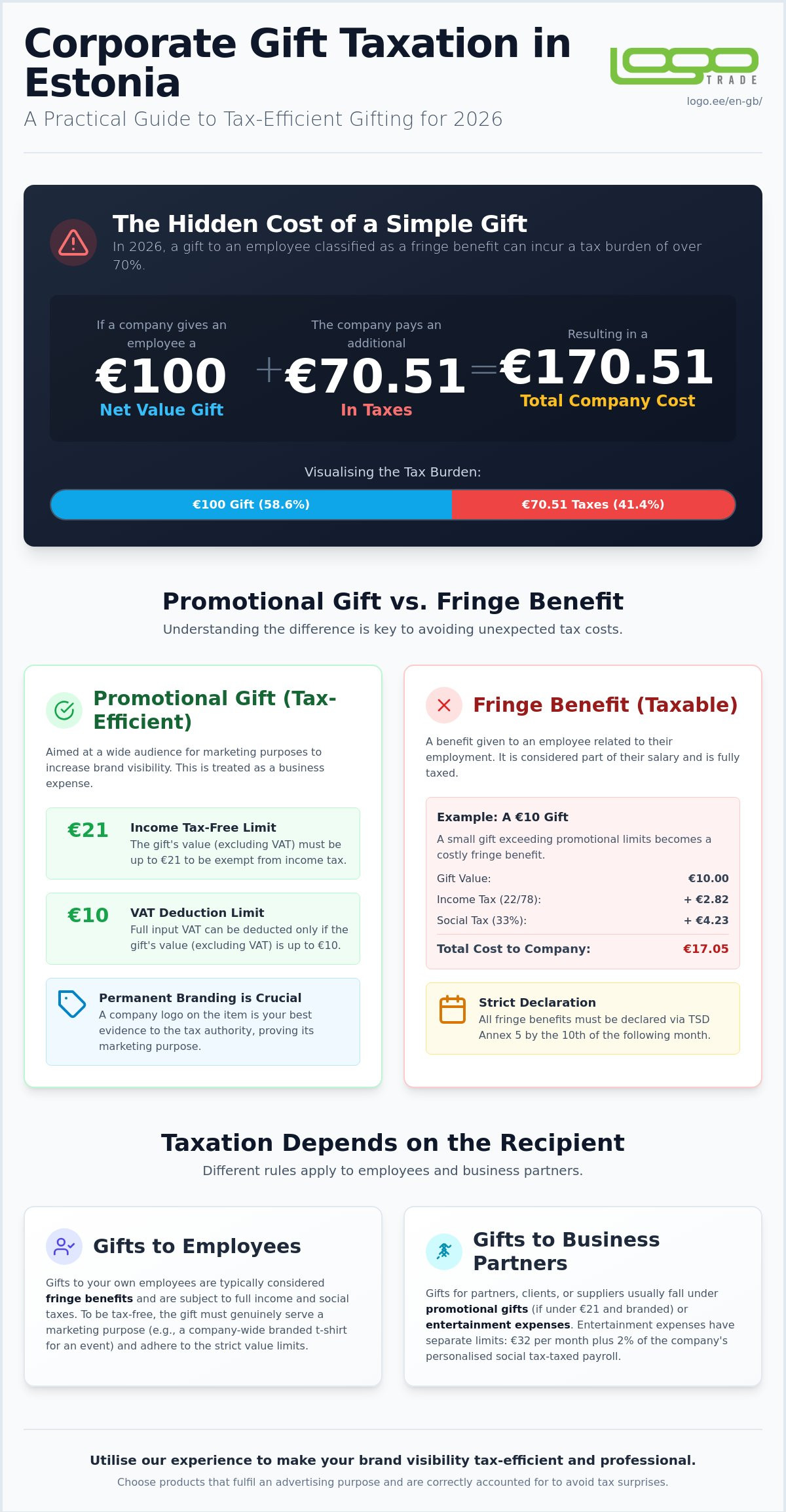
Did you know that in 2026, a 100-euro gift to an employee could cost a company a full 170.51 euros? This means that taxes account for over 70% of the gift's net value. Many business owners feel a justified uncertainty, as promotional gifts and fringe benefits seem like an endless maze, where every misstep could lead to a tax authority audit or unexpected additional costs. Have you ever felt you'd rather not give a gift than risk complicated declaration?
We completely understand this concern. In this practical guide, you will learn about the nuances of Estonian tax laws and strategies that allow you to make smart business gifts without the burdensome fringe benefits tax. We will provide you with specific tax-free limits, such as the 21-euro income tax-free threshold for promotional gifts, and a list of products that meet all requirements. After reading, you will have a clear understanding of how branded products turn an expense into a valuable investment and give you complete confidence in declaration. Utilise our over 21 years of experience to make your brand visibility tax-efficient and professional.
Key Points
- Gain a clear overview of 2026 tax rates to avoid nearly 71 per cent tax and additional costs on gifts given to employees.
- Learn to utilise the 21-euro tax exemption limit, which helps clearly distinguish between promotional gifts and fringe benefits tax.
- Understand why a permanent logo and branding are your best evidence to the tax authority, confirming the item's marketing purpose.
- Differentiate between the taxation of gifts for business partners and employees to keep company costs under control and avoid tax surprises during declaration.
- Find a list of practical products that always fall within the tax-free limit but offer long-term advertising value for your brand.
Fringe Benefits Tax on Gifts in 2026: Rules and Rates
For Estonian businesses, giving gifts is a strategic choice, but without accurate tax accounting, it can become unexpectedly costly. The 22 per cent income tax rate applicable in 2026 makes calculating the value of every gifted item critical. The definition of a fringe benefit is simple: it is a financially assessable benefit that an employer provides to an employee in connection with their employment relationship. This means that if a gift is not directly related to advertising or exceeds the legally permitted limits, it is considered an addition to the employee's salary and is taxed with full stringency.
All fringe benefits must be declared via TSD Annex 5 by the 10th day of the following month. This requirement is strict, and in 2026, the Tax and Customs Board will monitor particularly closely that promotional gifts and fringe benefits are clearly differentiated in accounting. If declaration is forgotten or expenses are misinterpreted, the consequences can include interest and audits, which waste your valuable time.
Why are taxes on gifts your budget's enemy?
The tax burden can seem overwhelming if you don't delve into the numbers. Let's take a simple example: if you decide to give an employee an item costing 10 euros, which is classified as a fringe benefit, your cost is not just 10 euros. With 2026 rates, this is subject to income tax (22/78, or 2.82 euros) and social tax (12.82 euros * 0.33, or 4.23 euros). In total, this small promotional item will cost the company 17.05 euros. This is over 70 per cent in additional costs! This is why the Logotrade blog recommends planning all purchases strategically in advance to avoid double taxation and keep costs under control through correct classification.
Key Terms: Gift vs. Donation vs. Entertainment Expense
To remain compliant with the law, you need to understand the nature of these terms. A corporate gift, in the eyes of the Income Tax Act, usually falls under either a promotional gift or an entertainment expense. A promotional gift is aimed at a wide range of individuals, and its tax-free limit in 2026 is 21 euros (excluding VAT). However, if you are hosting business partners, entertainment expense limits apply (32 euros per month plus 2 per cent of personalised social tax-taxed payments).
It is also important to distinguish between sponsorship and advertising. Sponsorship is often a donation, subject to different rules, whilst promotional gifts and fringe benefits are directly related to increasing a company's brand visibility. Use these limits wisely. A strategic approach allows you to impress partners without the amount paid to the state exceeding the value of the gift itself. Choose products that fulfil an advertising purpose and are correctly accounted for.
Promotional Gift vs. Fringe Benefit: How to Stay in the Tax-Free Zone?
The line between tax-free marketing expenditure and a taxable gift is thin, but knowing it can save your company thousands of euros. Promotional gifts and fringe benefits are topics where making a mistake is costly. In 2026, strict rules determine when you can reclaim VAT on expenses and when you have to pay additional taxes to the state. The main difference lies in who the item is given to and for what purpose. If the gift is aimed at a wide range of individuals for marketing purposes, the path to tax exemption is open. However, if the circle of recipients is limited and personalised, the situation becomes more complex.
When accounting for VAT, Estonia applies the so-called 10-euro rule. This means that a company is entitled to deduct input VAT in full from a promotional gift only if the value of the gift, excluding VAT, is up to 10 euros. If the price of the item exceeds this limit, the right to deduct VAT is completely lost. This is a critical point in budget planning. By choosing more affordable, yet high-quality promotional items, you immediately optimise your tax burden.
The 21-euro rule and promotional gifts: myths and reality
Many business owners confuse VAT and income tax limits. The document Income Tax Act stipulates that a promotional gift is income tax-free if its value, excluding VAT, is up to 21 euros. This is the amount that the Tax and Customs Board accepts as a marketing expense without additional taxation. However, if you wish to give something more expensive, you must be able to prove that it is part of a larger campaign. The importance of documentation cannot be underestimated here. Every expense invoice must clearly state the name of the event or campaign. Without this, it is easy for the tax authority to classify the expense as a fringe benefit or entertainment expense.
What is considered advertising aimed at a wide range of individuals?
The key marketing term "wide range of individuals" means that you do not select recipients by name. Fairs, public campaigns, and client events are solid grounds for obtaining tax exemption. If you distribute branded pens or reflectors at a trade fair booth to everyone who wants them, it is a pure advertising expense. Problems arise when the gift is named. A gift made to a specific person is often a red flag for the tax authority, indicating an entertainment expense or a fringe benefit.
When hosting business partners, the entertainment expense limit applies: 32 euros per month, plus 2 per cent of the company's social tax-taxed payments. This is a narrow framework that requires ingenuity to fit into. Logotrade services offer you support in planning precisely such tax-efficient campaigns. We help you choose products that fulfil their purpose, stay within tax-free limits, and emphasise your brand's professionalism without unnecessary tax surprises.
Logo Print as Proof of Tax Exemption: Branding is Financially Beneficial
The presence of a logo on a product is not merely a marketing choice, but your primary legal defence against the tax authority. Promotional gifts and fringe benefits are topics where the line is often blurred, but permanent branding draws a clear distinction. If the gifted item is marked with the company's symbolism, it becomes an advertising tool instead of a personal benefit. This is a critical argument because a logo makes the item less suitable for private use and emphasises its commercial purpose. The tax authority views a branded product as an expense incurred to promote business, not to financially enrich the recipient.
It is important to choose the right method of marking. Stickers and other temporary solutions may not be sufficient to convince auditors of the product's advertising nature. Prefer permanent technologies such as silk screen printing, engraving, or embroidery. These methods ensure that your brand remains on the product throughout its lifespan. This is a financially beneficial investment, as permanent marking is the best way to avoid a situation where an expensive promotional item is classified as a personal benefit and taxed in full according to 2026 rates.
Branding that saves taxes and increases recognition
The size and visibility of the logo play a significant role in classification. If the branding is too subtle or hidden, doubt may arise as to whether it is indeed advertising. Professionally executed engraving on metal thermoses or high-quality embroidery on clothing clearly shows that the item is intended to represent the brand. In the Logotrade portfolio, you will find numerous examples where we have helped clients find a balance between aesthetics and tax-efficient visibility. Strategic placement ensures that the product is recognisable, yet stylish, motivating the recipient to actually use it.
How to formalise a gift handover report?
Documentation is your second line of defence against unexpected tax liabilities. A correct handover report or campaign summary should include the following information:
- Date and event: Within which campaign, fair, or event gifts were distributed.
- Product list: Exact quantity and description of items.
- Logo description: A note that the products are marked with the company logo (include the printing technology name).
- Evidence: Attach a photo of the marked product to the report or invoice.
A common mistake is that gift distribution is only formalised with an expense invoice without further explanation. The tax administrator may years later request evidence that it was indeed advertising. Keep one sample product from each batch or at least a high-quality photo in the company's digital archive. This small step prevents tax disputes and gives you complete confidence that your promotional gifts and fringe benefits are correctly managed.
Gifts for Employees vs. Business Partners: How to Avoid Tax Surprises?
The Estonian tax system makes a clear distinction between whether the recipient of a gift is your own employee or an external business partner. This is where many companies make mistakes, assuming that a branded promotional item is always tax-free. In reality, a gift given to an employee is almost without exception a fringe benefit. This means that in addition to the price of the item, you must pay both income tax and social tax. For business partners, the rules are more flexible, but require precise documentation and adherence to limits. Promotional gifts and fringe benefits are topics that require two completely different approaches in accounting.
Special attention must be paid to foreign partners. If you give promotional items to a company located outside Estonia, you must be able to prove the existence of a business relationship. For VAT refunds, it is important that the expense invoice is correctly formalised and related to business activities. Without corresponding evidence, the tax authority may interpret it as a donation to a private individual, which incurs an additional tax liability. Ensure you have all necessary documents confirming the partner's legal status.
Motivating employees without tax surprises
So, how do you motivate your team without a huge tax bill? One of the best ways is to use a health package. The law allows spending 100 euros per employee per quarter tax-free on health-related expenses. This also includes sports clothing and accessories if they are aimed at promoting health. Another smart strategy is branded workwear. If you give an employee a high-quality fleece jacket or softshell jacket with permanent branding, and it is used for work duties or as representative clothing, it is not a gift, but a work tool. This is an excellent way to combine brand visibility and employee satisfaction without paying fringe benefits tax.
Thanking business partners: strategic use of entertainment expenses
For partners, the method of handover plays a role. If you send a gift by post and its value is less than 21 euros, it is a pure advertising expense. However, if you hand over the gift during a joint lunch or meeting, it is often classified as an entertainment expense. The entertainment expense limit (32 euros per month plus 2 per cent of the payroll fund) allows for more expensive gifts if you have planned them correctly. We recommend combining a business gift and an entertainment expense within a single event, clearly noting the purpose of the event and the participants in the expense report. Choose dignified promotional gifts for your partners here, which fit within these frameworks and leave a professional impression of your company.
Smart Product Selection: The Best Tax-Free Corporate Gifts from Logotrade
Choosing the right product is not just a matter of taste. It is a strategic decision that determines whether your expense is an investment or wasted money. Promotional gifts and fringe benefits are topics where cleverness pays off. By choosing products that fall within the 21-euro income tax-free limit, you keep your marketing budget efficient. The best promotional gift is one that is practical, high-quality, and carries your message for years. Our experience shows that high-quality branding is key here.
If you are planning a more expensive gift, consider creating sets. By dividing a larger gift into parts, where each component is a separate promotional product, you can stay within the law and still offer the recipient a luxurious experience. It is important that each item serves a marketing purpose and is correctly branded. Here are our TOP 5 selections that always fall within the tax-free limit:
- High-quality notebooks: These are indispensable in the office and offer a large surface for conveying your message.
- Engraved metal pens: Unlike plastic, these last for years and create a professional image.
- Smart power banks: Technological promotional items offer real value and are in everyday use.
- Recycled fabric bags: These offer a large advertising surface in the cityscape and emphasise your green mindset.
- Branded water bottles: Healthy lifestyles are highly valued, and your brand accompanies the recipient both at the gym and in the office.
Practical and tax-free ideas for every sector
Different sectors require different approaches. In an office environment, classic supplies that are constantly visible still work best. In the technology sector, however, branded USB drives and chargers create value. These are items that are not thrown away but travel with the user from meeting to meeting. Environmentally friendly choices such as reusable bags have become standard, offering a low contact cost and wide visibility. Estonian-designed promotional items and high-quality branded products show that you care about details and value your partners.
Start your next campaign with Logotrade
Logotrade is an Estonian company with over 21 years of experience and a member of the Estonian Chamber of Commerce and Industry. We have served thousands of clients and know exactly which promotional gifts and fringe benefits go hand in hand so that your company benefits. Our experts do not just offer you products, but comprehensive strategic advice. We help you find the most tax-efficient solution that meets 2026 requirements and fits your budget. Do not leave your brand visibility to chance. Let us find the best solution for your company together!
Turn Your Business Gifts into a Strategic Investment
Your company's brand visibility does not have to mean a huge tax burden. We have made it clear that promotional gifts and fringe benefits are areas where conscious planning saves your company over 70 per cent in additional costs compared to incorrectly declared benefits. Always remember the 21-euro income tax-free limit for promotional gifts and ensure that every item has permanent branding. This is your best legal evidence to the tax authority, confirming the item's marketing purpose and eliminating any suspicion of personal gain.
Logotrade has been a stable partner and experienced market leader for Estonian businesses for over 21 years. As a member of the Estonian Chamber of Commerce and Industry, we offer certified expert advice to ensure that every item you choose is a purposeful tool, not just an expense item. Our professional team will help you navigate the 2026 tax rules and find the best comprehensive solutions according to your budget. Choose tax-efficient promotional gifts here! Start your next successful campaign today and give gifts smartly. Your brand deserves the best execution and complete confidence!
Frequently Asked Questions about Promotional Gifts and Taxes
Is a branded pen always a tax-free promotional gift?
A branded pen is a tax-free promotional gift only if its price is below 21 euros and it is distributed to a wide range of individuals. If you give an expensive pen to a specific business partner by name, the tax authority may classify it as an entertainment expense. Strategically, it is sensible to keep the prices of promotional items within the limit so that promotional gifts and fringe benefits do not cause unnecessary confusion in accounting.
What happens if the value of a promotional gift exceeds the 10-euro limit?
If the value of a promotional gift exceeds 10 euros excluding VAT, the company loses the right to deduct input VAT. This means that even if the gift is income tax-free up to 21 euros, you must pay VAT yourself for items over 10 euros. This is an important nuance in budget planning to avoid unexpected costs and keep the campaign cost-effective.
Are birthday gifts for employees tax-free?
Birthday gifts for employees are not tax-free and are almost always considered a fringe benefit. Since it is a financially assessable benefit given in connection with employment, both income tax and social tax must be paid on it. This makes the final cost of the gift to the company approximately 70 per cent more than the item's own cost, which is why it is important to plan such expenses in the budget.
How to declare gifts sent to foreign business partners?
Gifts sent to foreign business partners are declared in TSD Annex 5 similarly to Estonian partners. If it is a promotional gift with a value of up to 21 euros, it is income tax-free. More expensive gifts are classified as entertainment expenses. It is important to retain documents proving the recipient's connection to your business and the circumstances of the gift's handover to avoid tax disputes.
Does the logo have to be on the product itself, or is the packaging sufficient?
In the eyes of the tax authority, printing the logo directly on the product is preferred, not just on the packaging. Permanent branding on the product proves that the item is intended for advertising purposes and is not merely a personal benefit to the recipient. Packaging is usually discarded immediately, but a branded product advertises your brand for years and is more reliable evidence for applying tax exemption in case of an audit.
What are the entertainment expense limits in 2026?
In 2026, the tax-free limit for entertainment expenses is 32 euros per calendar month, plus 2 per cent of personalised social tax-taxed payments made in the same month. All expenses exceeding the limit are subject to income tax at a rate of 22/78. This system allows for hosting partners and giving gifts, but requires precise and monthly accounting.
Can VAT paid on a gift purchase always be reclaimed?
VAT paid on a gift purchase can only be reclaimed if it is a promotional item with a value of up to 10 euros excluding VAT. For all other gifts, including employee fringe benefits and more expensive business gifts, input VAT cannot be deducted. This is one of the most common mistakes businesses make when promotional gifts and fringe benefits topics first arise in accounting.